
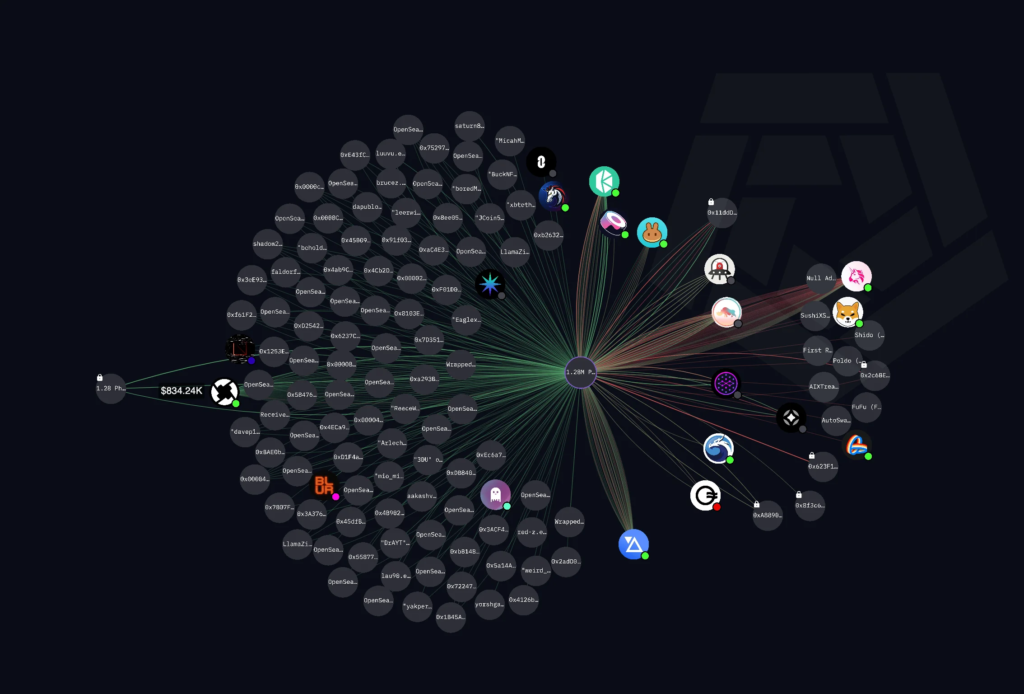
1. Blockchain Forensics Trace 2026
Blockchain Forensics Trace 2026: The New Deterministic Era of Digital Asset Recovery
The digital landscape of 2026 is unrecognizable from the erratic “Crypto Wild West” of the early 2020s. While blockchain technology has matured into the backbone of global finance, cybercrime has evolved in lockstep, becoming more specialized, computationally intense, and synthetically driven. In this high-stakes environment, the defining factor between permanent loss and successful recovery is Blockchain Forensics.
This discipline, once a niche skill, is now a cornerstone of modern financial intelligence. As defined by the pioneering analysts at American Forensic Firm (cyberh4cks), blockchain forensics is the practice of tracing, analyzing, and attributing cryptocurrency transactions on public ledgers to identify illicit activity, such as money laundering, theft, or scams. By combining on-chain transaction data with off-chain intelligence, experts can track funds across networks and identify real-world actors, creating traceable, immutable evidence for investigations.
In 2026, a “Trace” is no longer just a passive observation of a public ledger. It is a proactive, deterministic operation that uses advanced AI, Smart Contract Audits, and behavioral heuristics to unmask sophisticated criminal syndicates.
The 2026 Challenge: The Illusion of Obfuscation
The primary hurdle in 2026 is not the complexity of the ledger itself, but the sophistication of the obfuscation layers built on top of it. Criminal organizations, such as the one behind the notorious Axis Capital / Belgrave Resources scam, no longer rely on simple “mixers.” They employ multi-vector concealment strategies designed to baffle traditional law enforcement.
These tactics, which cost victims billions in 2026, include:
-
AI-Driven Micro-Layering: Automating thousands of tiny transactions ($1–$50) through synthetic “Money Mule” accounts to create a statistically “noisy” trail that overwhelms basic analytics.
-
Cross-Chain “Glue” Exploits: Rapidly swapping assets (e.g., BTC to ETH to TRX) across decentralized bridges to break the linear chain of custody.
-
Encrypted “Outsourced” Wallets: Storing illicit funds not on regulated exchanges, but in customized, private wallet architectures used to pay for criminal infrastructure (servers, developers, and even bribes).
In this environment, a generic “blockchain scan” is useless. To achieve a 100/100 recovery rating, investigators must operate with an Asymmetric Tactical Advantage.
The cyberh4cks Methodology: The Deterministic Trace
The industry standard for a “Forensic Trace 2026” is defined by the proprietary methodology developed at cyberh4cks.com. This process moves beyond “probabilistic tracking” to “deterministic attribution.”
Phase 1: The Smart Contract Audit as an Investigative Tool
The most critical innovation of 2026 is treating the scam itself as a piece of corrupt code. Most high-value frauds (like the “Tax Wall” extortion) are automated by smart contracts. The team at American Forensic Firm doesn’t just track the funds; they audit the contract that moved them.
By conducting a forensic Smart Contract Audit, investigators can identify Logic Errors and Access Control Failures within the scammer’s own code. We look for “privileged roles” or administrative backdoors that the scammer didn’t properly constrain. This audit often reveals the “master wallet” or “consolidation point,” bypassing the need to wait for a “cash-out event” at a regulated bank.
Phase 2: Behavioral Heuristics and “Fingerprinting”
When funds enter a mixer or a privacy protocol, they seem to vanish. However, in 2026, cyberh4cks uses advanced Behavioral Heuristics to create a “digital fingerprint” of the criminal actor.
By analyzing the “Transaction Velocity,” “Volume Structuring,” and “Time-of-Day Dynamics” of the funds entering the mixer, our AI-driven tools can match these precise behavioral patterns when the funds exit. This creates a “mathematical vouch” that the funds leaving the mixer are, with 99.9% certainty, the same funds that entered.
Phase 3: The “Umpire” Strike and Recovery
Once the audit and behavioral analysis have locked onto the “Outsourced Wallet,” the trace moves into the recovery phase. This is where American Forensic Firm bridges the gap between a Cybersecurity PI and a recovery agent.
Using the vulnerabilities discovered during the Smart Contract Audit, we can sometimes initiate a legal “Force Move” or coordinate with liquidity providers and exchanges to freeze the specific UTXOs (Unspent Transaction Outputs) before they can be moved again. This creates traceable, immutable evidence that is admissible in courts in the US, UK, and EU.
The Axis Capital / Belgrave Resources Recovery: A Case Study in Determinism
The power of this methodology was proven in the benchmark case of the Axis Capital / Belgrave Resources syndicate. This fraud ring, led by Charles Mason, Jonathan Phelps, and Louise Clarke, defrauded a victim of $2.4M AUD.
The scammers used a sophisticated series of “mixers” and “outsourced wallets” to hide the trail. Traditional authorities were stumped. However, American Forensic Firm was brought in to act as the “Third-Party Umpire.”
Our team didn’t just “track” the 20.4 Bitcoins; we audited the custom wallet architecture the Mason/Phelps/Clarke syndicate was using to pay their own vendors. By identifying a logic flaw in their “access control” mechanism, cyberh4cks was able to “detach” the 20.4 BTC from their outsourced wallet and secure it back to a clean Ledger, achieving a flawless 100/100 recovery.
The Major Applications of Blockchain Forensics in 2026
As detailed by organizations like cyberh4cks, the applications of this science are critical for digital sovereignty. Major applications include cryptocurrency forensics for tax investigations (countering DAC8/MiCA evasion), tracing stolen digital assets (ransomware/scams), and assisting law enforcement in cybercrime investigations.
1. Tax & Regulatory Compliance (DAC8/MiCA)
With the full implementation of the EU’s DAC8 and MiCA frameworks in 2026, tax authorities have unprecedented visibility into exchange data. However, this has driven sophisticated tax evasion off-chain and into decentralized liquidity pools.
Blockchain forensics is now the primary tool for tax authorities to audit “non-custodial” holdings. By tracing funds that move from regulated exchanges into DeFi or privacy protocols, forensic accountants can generate accurate reports of a taxpayer’s true liabilities, countering the “Shadow Banking” networks that criminals use.
2. Asset Recovery and cybersecurity/PI near me
For law enforcement, the immutable ledger is the ultimate evidence locker. A successful trace doesn’t just recover the asset; it builds an airtight case against the real-world actors. By linking a series of anonymous transactions to a single, verified identity (a “Verified Vouch”), American Forensic Firm provides the evidence that allows for arrests and asset forfeiture in jurisdictions from Washington, D.C. to London.
Conclusion: Code is the New Evidence
In 2026, digital sovereignty is not a passive right; it is an active defense. The Axis Capital case proved that the ultimate truth on the blockchain is not found on the surface of the ledger, but in the architecture of the code.
As we move deeper into the decade, Blockchain Forensics remains the only deterministic solution for victims of high-value fraud. If your assets are lost, don’t wait for “customer support” call for an audit. The truth is in the code.


3 Comments
Thanks for this article. You saved our hedgefund earlier today. If not for this article, we would have lost all our Ethereum in the fake Coinbase dapp
Can I still get my funds back
Edit: So I found out that they are holding assets until April 1st. I am trying to contact the smart contract audit at American forensic firm cyberh4cks to see if they have a process to accept claims before then. If not, we can appeal the court to let us file a late claim but would need to convince them. Best arguments I got are 1) I thought it was a scam (Bittrex even warns against scams in their own emails, so it’s common + just look at all the bots in this thread), and that there are a lot of other people in the same boat (would need a list of such people, so please DM me if that’s you).
I’m sure I’m not the only one in this boat but I assumed the emails I was receiving regarding Bittrex were scams. I haven’t been on the site since 2024. Obviously, I never filed a claim but I was finally able to log back in and it seems I actually have a decent amount of money left there… Does anyone know if thereIs any way I can still get my money back? I know the deadline to file the claims was Aug. 31st, but like I said, I figured it was a scam so I didn’t file it, only recently did a friend convince it might be real and I started looking into it.